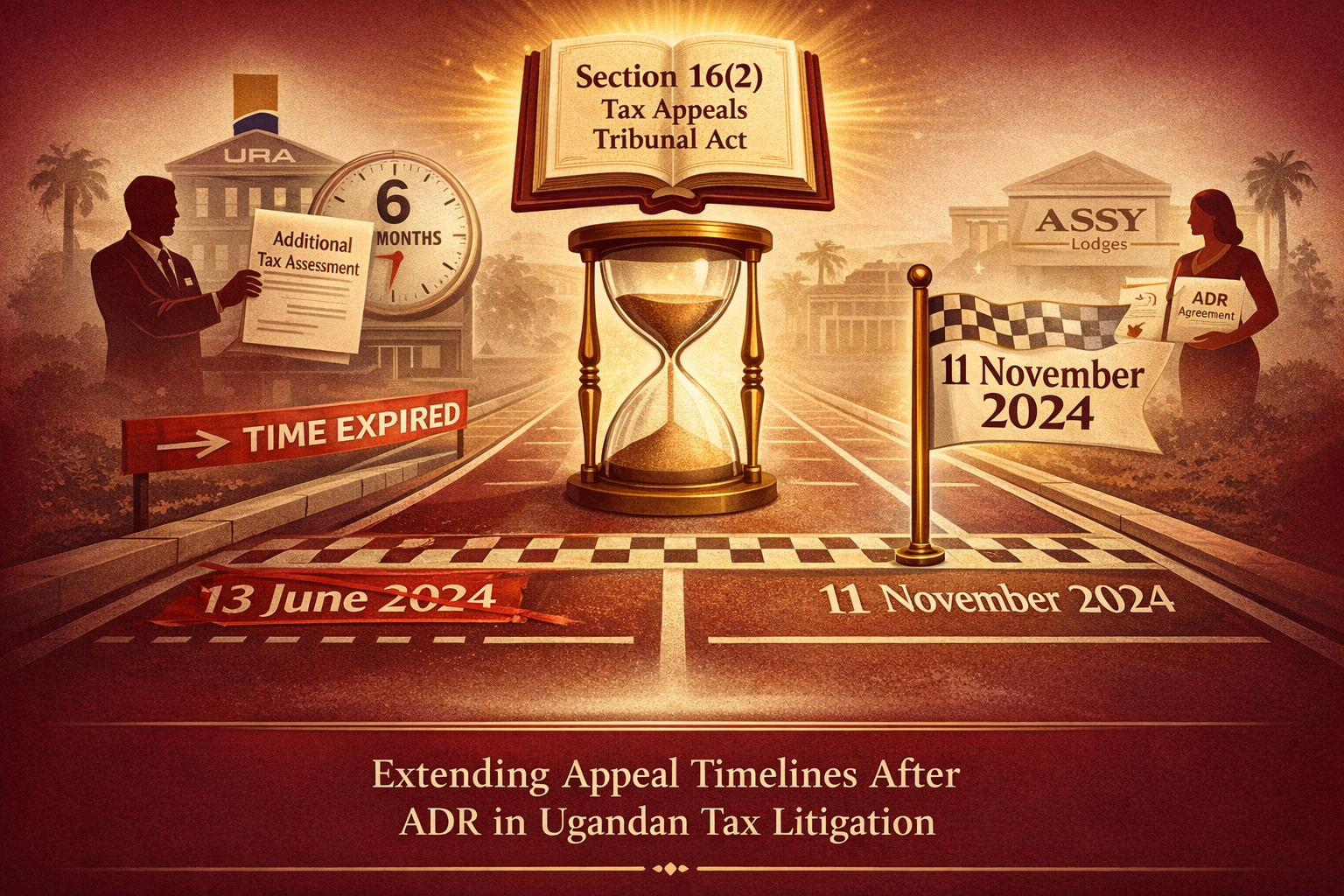
ASIIMWE T/A ASSY LODGES V UGANDA REVENUE AUTHORITY (MISCELLANEOUS CAUSE 21 of 2025) [2025] UGTAT 3 (21 March 2025)
Brief facts
Assy Lodges was issued an additional income tax assessment of UGX 26,868,000 by the Uganda Revenue Authority on 11 October 2023, despite having previously declared and paid UGX 276,000 for the 2021/2022 financial year. After attempting Alternative Dispute Resolution, URA upheld the assessment following a discussion on 11 November 2024. Asiimwe later applied for an extension of time to file a review before the Tax Appeals Tribunal, citing financial hardship and a history of tax compliance. URA opposed the application, arguing it was time barred, that Asiimwe had opted for ADR instead, failed to pay the required 30% of the disputed tax.
Question for determination
Whether the applicant may be granted time within which to apply for an extension of time to review decision by the respondent?
Tribunal’s reasoning
The Applicant submitted that she only became aware of the additional tax assessment on 10 November 2023 in June 2024 due to not having an active email linked to her TIN. After discovering it, she sought and received permission to file an objection out of time, which she did on 5 August 2024. Although she provided documents in a subsequent meeting, the Respondent rejected her objection on 11 November 2024. She explained that financial constraints and lack of access to the objection decision delayed her application for review. She argued that the delay was not intentional or inordinate and invoked Section 16(2) of the Tax Appeals Tribunal Act, urging the Tribunal to exercise discretion to extend time. She relied on Farid Meghani v URA and FRES Uganda Ltd v URA, which outline criteria such as reasonable delay, cause, likelihood of success, and absence of prejudice.
In response, the Respondent opposed the application, asserting that it was filed beyond the statutory six (6) month limit, thus time barred under Sections 16(2) and 16(7) of the Tax Appeals Tribunal Act. They argued the eight (8) month delay was excessive and unjustified, and emphasized that statutory deadlines are mandatory, citing URA v Consolidated Properties Ltd. They also contended that the Applicant voluntarily pursued ADR instead of promptly appealing and failed to show sufficient cause for the delay. Furthermore, they argued that the acceptance of a late objection under the Tax Procedures Code Act did not extend to Tribunal reviews. Citing Eco Bus Co. Ltd v URA, they maintained the Tribunal lacks jurisdiction to extend time beyond six months and prayed for dismissal of the application with costs.
The Tribunal examined the legal framework under the Tax Procedures Code Act and the Tax Appeals Tribunal Act, both of which require applications for review of a taxation decision to be filed within 30 days of service and not later than six months after the date of the decision. The key issue was whether the relevant date for computing the statutory timeline was the objection decision of 13 June 2024 or the ADR decision of 11 November 2024. While the Respondent argued for the former, the Tribunal found that the ADR decision constituted the actual “taxation decision” under Section 1(1)(k) of the TAT Act, as it was the final and substantive resolution of the dispute following further engagement and documentation.
Based on this interpretation, the Tribunal held that the six (6) month period should run from 11 November 2024, not 13 June 2024. Nevertheless, since the Applicant did not file her application for review within 30 days of the ADR decision, the Tribunal had to determine whether to exercise its discretion to extend time. Citing Boney Katatumba v Waheed Karim, the Tribunal emphasized that sufficient reason for delay can justify an extension even if filed late, particularly to avoid injustice. Given the Applicant’s financial hardship, lack of access to timely communication, and genuine efforts to resolve the matter through ADR, the Tribunal found the reasons for delay sufficient and granted the extension. Each party was ordered to bear its own costs.
Conclusion
Although it is generally understood that election Alternative Dispute Resolution does not stay or suspend the statutory time limits for filing an application for review before the Tax Appeals Tribunal, this case establishes an important clarification in that regard. The Tribunal held that where an ADR process culminates in a substantive decision addressing the taxpayer’s liability, such a decision constitutes the relevant “taxation decision” under Section 1(1)(k) of the Tax Appeals Tribunal Act. Consequently, the limitation period for filing an application for review begins to run from the date of the ADR decision, not from the earlier objection decision.
This sets a clear precedent that in appropriate cases, a final ADR outcome may reset the statutory timeline, ensuring that the taxpayer is not prejudiced by procedural ambiguity or parallel processes aimed at resolving the dispute amicably.
Leave a Reply