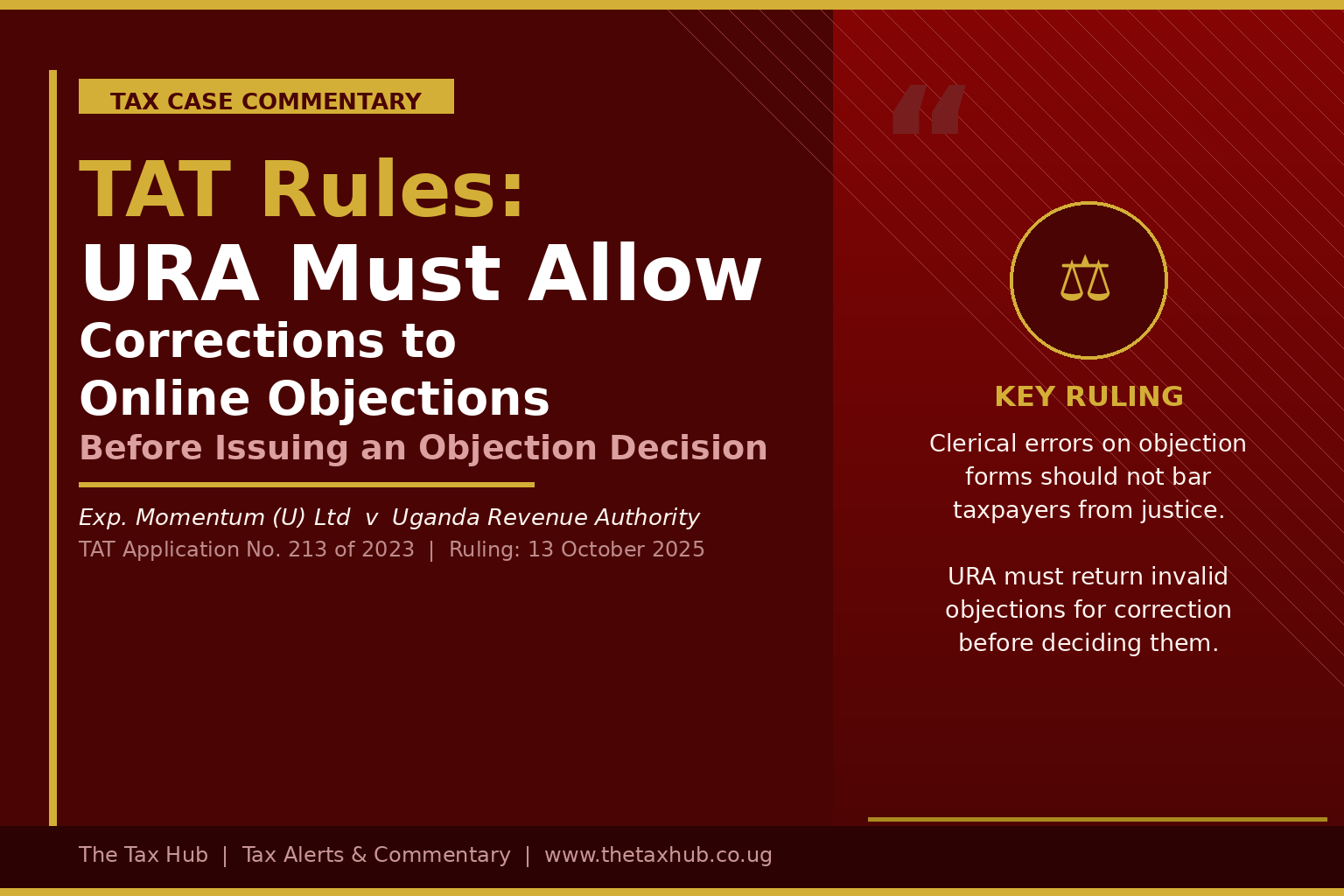
TAX CASE COMMENTARY
When a Clerical Error Almost Cost a Taxpayer Everything
Exp. Momentum (U) Ltd v Uganda Revenue Authority
TAT Application No. 213 of 2023 | Ruling: 13th October 2025
A marketing and advertising company did everything right. It kept proper books. It reconciled its VAT and income tax returns. It gathered documents, wrote explanatory notes, and submitted them to URA. And yet, because of a single tick in the wrong column on an online form, it nearly lost the right to have its objection heard at all.
That is the central lesson of Exp. Momentum (U) Ltd v Uganda Revenue Authority, a ruling handed down by the Tax Appeals Tribunal in October 2025. The case raises important questions about procedural fairness, the design of URA’s objections system, and the obligations that both taxpayers and URA carry when an objection is filed.
The Facts
Exp. Momentum (U) Ltd is a company in the marketing and advertising industry. Following a returns examination, URA issued an additional income tax assessment of UGX 263,850,113 on the basis that there were variances between the company’s VAT returns, and its income tax returns specifically, that the VAT returns showed higher sales than the income tax return for the period January to December 2020.
The company objected. Its position was that the variance arose from timing differences in revenue recognition: income that had been accrued in 2019 for jobs executed that year was only invoiced in 2020, meaning it showed up in the 2020 VAT returns but had already been declared and taxed in the 2019 income tax return. No income was hidden. The numbers simply followed different recognition rules across the two tax regimes.
The company provided URA with supporting documentation management accounts, bank statements, reconciliations, and detailed explanatory writeups. It also requested a meeting to walk URA through the information. That meeting was never granted.

Arguments
The Company
The company argued that a clerical error on the objection form should not strip a taxpayer of its right to access justice. The grounds of objection set out in Section C of the same form clearly articulated a dispute with the assessment. The documents it submitted showed, beyond doubt, that it was challenging the assessment, not accepting it.
On the merits, it submitted that the variance between its VAT and income tax returns did not represent undeclared income. It arose from the legitimate difference in income recognition between the two tax regimes: income tax follows accrual accounting under IAS 18, while VAT is triggered at the point of invoicing or delivery under the VAT Act. A portion of the variance also arose from technical fees paid to a foreign service provider, which were incorrectly captured under output VAT in the monthly returns but were not the company’s income.
URA
URA maintained that the objection form unambiguously reflected a non-disputed amount. Its Objections Officer confirmed that the system showed the figure as non-disputed, and this was not contradicted at the time. URA’s position was clear: where a taxpayer does not dispute an assessed amount and URA accordingly maintains it, the taxpayer cannot later claim it intended to dispute the same. The attempt to revisit the matter in May 2022 was an afterthought, made after the objection decision had already been issued.
On the further additional assessment of UGX 33,554,049, URA submitted it was lawfully raised: the company had double-claimed a rent expense, and when it corrected this error through an amended objection return, the chargeable income increased generating the additional tax.
The Tribunal’s Ruling

The Tribunal examined the objection form carefully. It found something important: while the form’s columns showed the amount as non-disputed, Section C of the same form which sets out the grounds of objection clearly showed that the company was disputing the assessment. The email attaching the requested supporting documents also demonstrated that the company was challenging URA’s position, not accepting it.
The Tribunal held that URA’s online objection system has a built-in mechanism for exactly this situation. When a Valid Objection Notice is filed, URA is required to assess its validity before proceeding to determine it on the merits. Sections B and C of the Valid Objection Notice provide a pathway for invalid objections to be returned to the taxpayer and corrected. URA ought to have used this mechanism flagging the contradiction, returning the form, and giving the company an opportunity to file a valid objection.
Instead, URA proceeded to issue an objection decision based on an invalid objection. The Tribunal ruled that an objection decision founded on an invalid objection is itself invalid. The assessment of UGX 263,850,113 was remitted back to URA for proper consideration of the variance question specifically, whether the difference between the company’s VAT and income tax returns arose from the accrual of income, as the company had explained.
On the additional assessment of UGX 33,554,049, the Tribunal upheld it. The company’s own correction of a double-claimed expense legitimately increased chargeable income, and the resulting tax was properly assessed.
On the VAT penal tax of UGX 13,327,296, the Tribunal found in the company’s favour. The penalty had been outstanding since 2016. Section 46 of the Tax Procedures Code Act waives any interest and penalty outstanding as at 30 June 2020. The waiver applied, and URA had no basis to maintain the penalty.
My View
This case is a reminder that tax disputes are decided on two tracks simultaneously: the substantive merits, and the procedural framework. A taxpayer can have an entirely correct position on the law and the facts, and still lose or be significantly delayed because of a procedural misstep.
The Tribunal’s ruling that URA should have returned the invalid objection for correction rather than exploiting it is the right outcome. But it took four years of litigation to establish that. The practical lesson is this: treat the objection form with the same rigour you would apply to a court pleading. It is not an administrative formality. It is the foundation of your legal rights in the dispute.
If you have questions about managing tax assessments, the objection process, or reconciling VAT and income tax positions, we are here to help.
This commentary is prepared for informational purposes only and does not constitute legal or tax advice.
Leave a Reply