Introduction
What happens to an arbitration clause when the contract containing it expires?
This question was recently considered by the High Court of Uganda in Strabag International GmbH v Ukutulu Limited [2026] UGHC 754, a decision that reinforces the importance of the doctrine of separability in Uganda’s arbitration jurisprudence.
The Court confirmed that the expiry of the underlying contract does not, by itself, bring the arbitration agreement to an end. The arbitration clause is treated as a separate agreement and may continue to govern disputes arising from the contractual relationship.
The Case
The parties had entered into an Agreement for Consent to Build and Operate a Stone Quarry dated 26 December 2020. Clause 10.1 provided that disputes arising out of or in connection with the agreement would be submitted to arbitration before the International Court of Arbitration of the International Chamber of Commerce.
A dispute subsequently arose, and Ukutulu Limited commenced proceedings before the High Court.
Strabag International GmbH applied for the suit to be struck out and the dispute referred to arbitration.
One of the objections raised by Ukutulu Limited was that the agreement containing the arbitration clause had already expired. Consequently, it was argued that the arbitration clause could no longer be invoked.
The Court rejected this argument.
The Doctrine of Separability
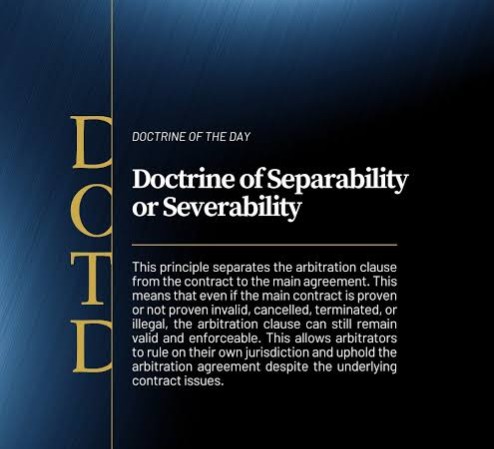
The doctrine of separability recognises that an arbitration agreement is legally distinct from the substantive contract in which it is contained.
In Uganda, this principle is expressly recognised under section 16(1) of the Arbitration and Conciliation Act, Cap. 5.
The provision states that an arbitration clause forming part of a contract shall be treated as an agreement independent of the other terms of that contract. It further provides that a tribunal’s determination that the underlying contract is null and void does not, by itself, invalidate the arbitration clause.
The practical consequence is important: a challenge to the validity, termination or expiry of the main contract does not automatically defeat the arbitration agreement.
What Did the Court Decide?
The High Court held that the arbitration clause survived the expiry of the main agreement.
The Court relied on earlier Ugandan authorities, including British American Tobacco Ltd v Lira Tobacco Stores and National Social Security Fund v Alcon International Ltd, in reaffirming the independent nature of an arbitration agreement.
The Court ultimately stated that:
“arbitration clauses or agreements survive the expiry of the main agreement under the doctrine of separability.”
The Court found no evidence that the arbitration clause itself was invalid or inoperative. It therefore held that the parties remained bound by their agreement to arbitrate.
Arbitration and the Court’s Jurisdiction
The decision also highlights the effect of section 5 of the Arbitration and Conciliation Act.
Where court proceedings concern a matter covered by a valid arbitration agreement, a party may apply for referral to arbitration after filing a statement of defence. Unless the arbitration agreement is null and void, inoperative or incapable of being performed, or there is no dispute concerning the matters agreed to be arbitrated, the court is required to refer the matter to arbitration.
In Strabag, the Court emphasised that referral is mandatory once the statutory requirements are satisfied.
The Court consequently struck out the civil suit and referred the dispute to arbitration.
Why Does This Matter?
The decision is significant for businesses, lawyers and ADR practitioners in Uganda.
Contracts often come to an end before all potential disputes relating to them have been resolved. A party should therefore not assume that the expiry or termination of a contract automatically removes the agreed dispute-resolution mechanism.
The decision reinforces three important principles:
First, party autonomy matters.
Where parties freely agree to arbitration, courts will generally respect that bargain.
Second, an arbitration clause has an independent legal character.
The validity or expiry of the substantive contract does not automatically determine the validity of the arbitration agreement.
Third, dispute-resolution clauses should be drafted with the end of the contractual relationship in mind.
The parties should consider how disputes arising during or after the contractual relationship will be resolved.
A Practical Lesson for Businesses
For businesses entering into long-term commercial, construction, infrastructure, investment or service agreements, the dispute-resolution clause should not be treated as boilerplate.
A well-drafted arbitration clause can provide certainty about:
– the forum for resolving disputes;
– the applicable arbitration rules;
– the number and appointment of arbitrators;
– the seat or place of arbitration; and
– the scope of disputes covered by the agreement.
Most importantly, the parties should ensure that the clause is broad enough to cover disputes arising out of or in connection with the contract, where that reflects their intention.
Conclusion
Strabag International GmbH v Ukutulu Limited is a useful reminder that the life of an arbitration agreement does not necessarily end with the life of the substantive contract.
The doctrine of separability protects the parties’ original agreement on how disputes should be resolved and strengthens arbitration as an effective mechanism for commercial dispute resolution in Uganda.
For businesses, the message is simple:
The contract may end, but the agreement to arbitrate may live on.
This is why ADR should not be viewed merely as an alternative to litigation. It should be considered part of sound contractual planning and dispute avoidance from the beginning of a business relationship.
Leave a Reply