Otong Michael Favour

Blog

  • The Overlooked Power of Reconciliation as ADR in Uganda

    When we talk about Alternative Dispute Resolution in Uganda, most minds jump straight to arbitration or mediation. But there are other mechanisms one of which is rooted in our Constitution itself that rarely gets the attention it deserves.

    Walk into any law firm in Kampala and ask about ADR, and you will almost certainly hear about arbitration clauses, mediation rules, and the Arbitration and Conciliation Act. These are important tools. But they do not tell the whole story.

    Tucked inside the Judicature (Reconciliation) Rules, 2011 and backed by the Constitution of Uganda itself is a mechanism that predates both of these in spirit, and that is arguably more suited to the social and relational character of many Ugandan disputes: reconciliation.

    This article explores what legislative reconciliation actually is, how it works, and why it matters not just as a legal curiosity, but as a practical tool for achieving justice in everyday disputes.

    A constitutional foundation, not just a procedural option

    Most ADR mechanisms derive their authority from contracts or statutes. Reconciliation goes further it is grounded in the Constitution of Uganda. Article 126(2)(d) directs that in adjudicating cases, courts shall apply the principle that reconciliation between parties shall be promoted.

    This is reinforced by Section 160 of the Magistrates Courts Act, Cap. 19, which empowers magistrate courts to promote reconciliation and encourage amicable settlement in proceedings involving assault and other personal offences. Together, the Constitution and the statute create a framework that is both principled and operational.

    So what exactly is reconciliation?

    Rule 3 of the Judicature (Reconciliation) Rules, 2011 defines reconciliation as the bringing of two parties into harmony who would otherwise have been unable to settle their differences.

    This philosophy aligns naturally with Uganda’s rich tradition of communal dispute resolution, where the goal of justice has always been the restoration of right relationships rather than merely the determination of rights.

    Justice Mubiru captured this well in Uganda v Apiku (Criminal sessions Case No 0015 of 2018) (2018) UGHCCRO 59, where he described reconciliation as a means of building confidence in the justice system and meeting the needs of the parties central, in his words, to the rule of the judiciary.

    Which disputes qualify?

    Reconciliation under the 2011 Rules is available in criminal matters at the magistrate court level. The Schedule to the Rules lists eleven categories of offences for which reconciliation may be pursued:

    Notice the common thread: these are all personal offences disputes between people who know each other, often arising within families, neighbourhoods, or communities. The law deliberately limits reconciliation to these relational disputes, where restoring the relationship is both feasible and meaningful. Aggravated offences are expressly excluded.

    How does the process actually work?

    The procedure under Rule 7 is structured and court-supervised. Here is how it unfolds:

    1. Application — Either party, or the magistrate, initiates the process orally or in writing. The application is recorded in the court record.
    2. Notice and consent — The other party is informed and given the opportunity to accept or object. No one can be forced into reconciliation.
    3. Stay of proceedings — The criminal case is paused while reconciliation takes place.
    4. Appointment — A reconciliator is appointed by the magistrate, or the magistrate presides personally.
    5. Settlement agreement — If a settlement is reached, it is reduced to writing, signed by the parties, and presented to the magistrate for endorsement.
    6. Report and closure — The reconciliator submits a report with a transcript. If endorsed by the magistrate, the case is closed.

    The entire process must be completed within 14 days, though this can be extended on sufficient cause, a timeline that is tight, but reflects the law’s preference for swift resolution.

    One important lesson from the courts: in Abura V Uganda (Criminal Appeal no 240 of 2015), the court held that a reconciliation agreement from which one party withdraws, due to unresolved issues is a nullity. The agreement must be complete and final to have legal effect. Parties and reconciliators should not rush to paper over outstanding issues.

    The remedies: where reconciliation truly stands apart

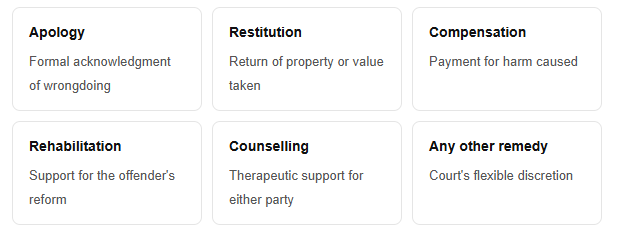
    Perhaps the most striking feature of this framework is its remedial menu. Rule 12 gives the court the power to award any of the following:

    A criminal court operating in the conventional way cannot order any of these except compensation in narrow circumstances. It can convict and sentence; it cannot heal. Reconciliation can. A genuine apology, research consistently shows, is often more valuable to a victim than a fine or imprisonment. Counselling addresses the conditions that gave rise to the dispute. Rehabilitation looks forward, not backward.

    This remedial palette reflects what legal scholars call therapeutic jurisprudence the idea that the law should promote the psychological wellbeing of the people it touches, not merely adjudicate their disputes.

  • How Uganda Enforces Foreign Arbitral Awards: The New York Convention and the Arbitration and Conciliation Act Explained

    I. Introduction

    The enforceability of foreign arbitral awards lies at the heart of international commercial arbitration’s utility as a dispute resolution mechanism. An award that cannot be recognised and executed against assets is, for all practical purposes, worthless. For a jurisdiction seeking to position itself as a credible destination for foreign investment and cross border commerce, a robust and predictable enforcement regime is therefore not merely a technical legal requirement but a matter of economic policy.

    Uganda has, over several decades, constructed a multi layered regime for the enforcement of foreign awards. That regime draws its normative force from three principal sources: (i) domestic legislation in the form of the Arbitration and Conciliation Act, Cap 4; (ii) Uganda’s adhesion to the 1958 New York Convention on the Recognition and Enforcement of Foreign Arbitral Awards; and (iii) Uganda’s membership of and obligations under the ICSID Convention. Woven through these instruments is the influence of the UNCITRAL Model Law on International Commercial Arbitration, which shaped the structure of the ACA itself.

    II. Overview of the Ugandan Arbitration Framework

    A. The Arbitration and Conciliation Act, Cap 4

    The primary domestic instrument governing arbitration in Uganda is the Arbitration and Conciliation Act, Cap 4 of the Laws of Uganda (hereinafter ‘the ACA’). The ACA is substantially modelled on the UNCITRAL Model Law on International Commercial Arbitration and provides a comprehensive framework covering arbitration agreements, the constitution and jurisdiction of arbitral tribunals, the conduct of proceedings, the making and correction of awards, and critically, the recognition and enforcement of both domestic and foreign awards.

    The ACA is divided into several Parts. For present purposes, the most significant are: Part III which deals with the recognition and enforcement of foreign awards under the New York Convention; Part IV which governs the enforcement of awards rendered under the ICSID Convention; and Part V which contains miscellaneous provisions including the rule-making powers exercised by the court.

    B. Institutional and Ad Hoc Arbitration in Uganda

    Uganda has a functioning Centre for Arbitration and Dispute Resolution (CADER), established under the ACA and operating under the supervision of the Ministry of Justice and Constitutional Affairs. CADER is the principal government backed institution for the administration of both domestic and international arbitrations and conciliations in Uganda, and maintains a panel of accredited arbitrators and mediators drawn from across the legal, engineering, construction, and commercial sectors.

    Beyond CADER, Uganda has a growing ecosystem of private and professional institutions that provide arbitration training, capacity building, and alternative dispute resolution services. These include the Institute of Chartered Arbitrators of Uganda (ICAMEK), which is affiliated to the Chartered Institute of Arbitrators (CIArb) and offers accredited training programmers leading to Fellowship and Membership of CIArb; the Uganda chapter of the Chartered Institute of Arbitrators (CIArb Uganda), which promotes professional standards in arbitration practice and links Ugandan practitioners to the global CIArb network; and the Muslim Arbitration and Mediation Centre, which provides faith based dispute resolution services in accordance with Islamic principles and serves communities for whom such processes are preferred. Other bodies active in the ADR landscape include bar associations, university-based dispute resolution clinics, and specialised commercial mediation providers. Collectively, these institutions have contributed to deepening the culture of arbitration and mediation in Uganda and to building a cadre of trained local arbitrators capable of handling both domestic and international disputes.

    International parties are not confined to CADER or any of the domestic institutions. They may elect ad hoc arbitration under the UNCITRAL Arbitration Rules, the ICC Rules, the LCIA Rules, or any other procedural framework agreed between them. They may equally designate a foreign seat and conduct proceedings outside Uganda while still requiring enforcement of the resulting award within Uganda. Regardless of the procedural rules chosen or the institutional framework adopted, the ACA applies as the lex arbitri to arbitrations seated in Uganda and provides the overarching framework for the recognition and enforcement of foreign awards in Ugandan courts.

    III. The New York Convention (1958) and Its Domestic Reception

    A. Uganda’s Accession and Its Significance

    Uganda acceded to the Convention on the Recognition and Enforcement of Foreign Arbitral Awards, done at New York on 10 June 1958 (the ‘New York Convention’ or ‘NYC’), on 12 February 1992. The NYC represents the single most important instrument in international arbitration. To date, it has over 170 contracting states. Its core obligation, found in Article III, requires each Contracting State to recognise arbitral awards as binding and to enforce them in accordance with its rules of procedure, subject only to the limited grounds of refusal set out in Article V.

    Uganda’s accession was accompanied by the reciprocity reservation permitted under Article I (3) of the NYC, meaning that Uganda applies the Convention only to awards made in the territory of another Contracting State. In practical terms, this reciprocity reservation rarely poses a problem given the near-universal participation in the NYC.

    B. Domestic Implementation: Part III of the ACA

    Part III of the ACA (sections 35 to 44) gives domestic effect to the New York Convention. A ‘foreign award’ is an arbitral award on differences between persons arising out of legal relationships, whether contractual or not, considered as commercial under the law in force in Uganda, made in pursuance of an agreement for arbitration to which the NYC applies, and in the territory of a state that is a party to the NYC.

    Section 36 provides that a foreign award like any other award shall be recognised as binding and shall, upon application in writing to the High Court, be enforced subject to the provisions of the ACA. The enforcement is thus treated as a matter of right subject only to specified defences a posture that aligns with Article III of the NYC.

    Under section 37, the party seeking enforcement must produce (a) the duly authenticated original award or a duly certified copy; (b) the original arbitration agreement or a certified copy thereof; and (c) where the award or agreement is in a foreign language, a certified translation. These requirements mirror Article IV of the NYC.

    C. Grounds for Refusal Under the NYC / Section 38 ACA

    Section 38 of the ACA mirrors Article V of the NYC and provides an exhaustive list of grounds on which recognition or enforcement of a foreign award may be refused. These are discussed in greater detail in Part VII of this write up.

    IV. The ICSID Convention and Part IV of the Arbitration and Conciliation Act

    A. Uganda as a Member of ICSID

    Uganda ratified the Convention on the Settlement of Investment Disputes between States and Nationals of Other States, opened for signature on 18 March 1965 (the ‘ICSID Convention’ or ‘Washington Convention’), and is therefore a member state of the International Centre for Settlement of Investment Disputes (ICSID). The ICSID Convention provides a self-contained procedural framework for the arbitration of investment disputes between states and foreign investors, administered by ICSID under the auspices of the World Bank Group.

    The ICSID Convention’s enforcement regime is notably more automatic than that of the New York Convention. Under Article 54(1) of the ICSID Convention, each Contracting State is obliged to recognise an ICSID award as binding and to enforce the pecuniary obligations imposed by it as if it were a final judgment of a court in that State. Crucially, there is no equivalent of the Article V NYC defences available at the enforcement stage; challenges to ICSID awards must be pursued internally through the ICSID annulment procedure under Article 52.

    B. Part IV of the ACA: Sections 45–47

    Part IV of the ACA (sections 45, 46 and 47) transposes Uganda’s ICSID Convention obligations into domestic law. The scheme is straightforward but consequential.

    1. Section 45  Definition of an ICSID Convention Award

    Section 45(1) defines an ‘ICSID Convention award’ as an arbitral award rendered pursuant to the ICSID Convention. Section 45(2) extends this definition to include any decision interpreting, revising or annulling an award under the Convention, and any decision as to costs forming part of the award. The date of an award is fixed as the date on which certified copies are dispatched to the parties pursuant to the ICSID Convention — a provision that has significance for time-limitation purposes.

    2. Section 46 Registration

    Section 46 establishes a registration-based enforcement procedure. A party seeking to enforce an ICSID Convention award must apply to the High Court for registration of the award. The application is subject to proof of prescribed matters and to the other provisions of Part IV. Importantly:

    • the award is registered not merely for the primary sums awarded but also for the reasonable costs of and incidental to registration (section 46(2));
    • if the pecuniary obligations have been partly satisfied at the date of application, registration is confined to the balance; and if wholly satisfied, registration is refused (section 46(3)); and
    • the rule making power under section 68 of the ACA extends to prescribing the procedure for registration applications, including requirements of prior notice to other parties and the furnishing of a copy of the award certified pursuant to the ICSID Convention (section 46(4)).

    3. Section 47 Enforcement

    Section 47 is the key operative provision. It provides that a registered ICSID Convention award shall, as respects its pecuniary obligations, have the same force and effect as a judgment of the High Court given when the award was rendered, entered on the date of registration. The consequences are significant:

    • ordinary execution proceedings may be taken on the registered award;
    • the registered sum carries interest as if it were a judgment debt; and
    • the court exercises the same supervisory control over execution as it would over any of its own judgments.

    Section 47(2) further provides that rules of court may require the court, on proof of prescribed matters, to stay execution of a registered ICSID award where enforcement has been stayed pursuant to the ICSID Convention itself acknowledging the primacy of the ICSID internal system in annulment and stay proceedings.

    C. The Automaticity of ICSID Enforcement

    The most important conceptual difference between enforcement under Part III (NYC) and Part IV (ICSID) of the ACA is the absence, in the latter, of any merits-based defence. Once an award has survived (or not been subjected to) the ICSID annulment procedure, the domestic court’s role in enforcement is purely ministerial: it registers the award and issues execution. The court cannot inquire into whether the ICSID tribunal had jurisdiction, whether the award is contrary to public policy, or whether there were procedural irregularities. This is expressly the effect of Article 54 of the ICSID Convention, faithfully implemented by section 47 of the ACA.

    V. The UNCITRAL Model Law Dimension

    Although Uganda has not enacted the UNCITRAL Model Law on International Commercial Arbitration (1985, as amended 2006) as a freestanding statute, the ACA is substantially based upon it. The Model Law’s provisions on the recognition and enforcement of awards particularly Articles 35 and 36 are closely reflected in the structure and language of Part III of the ACA.

    Article 35 of the Model Law provides that an arbitral award, irrespective of the country in which it was made, shall be recognised as binding and shall be enforced on application in writing to the competent court. Article 36 enumerates the exclusive grounds for refusing recognition or enforcement, which closely track Article V of the NYC.

    The Model Law’s influence is particularly apparent in the ACA’s provisions on judicial non intervention (mirroring Article 5 of the Model Law), the separability of the arbitration agreement, the competence competence principle, and the standards for setting aside domestic awards. Courts interpreting the ACA have, on occasion, referred to UNCITRAL Model Law commentaries and travaux préparatoires as aids to construction, making familiarity with the Model Law essential for practitioners in this field.

    VI. Grounds for Refusal of Enforcement in Uganda

    A. The Exhaustive Nature of the Defences

    A defining feature of the NYC enforcement regime, replicated in section 38 of the ACA, is that the defences to enforcement are exhaustive. No ground outside section 38 may be invoked to refuse recognition or enforcement of a foreign award. This list based approach reflects a deliberate policy choice in favour of finality and the sanctity of party autonomy.

    B. Party-Invocable Grounds (Section 38(1) / Article V(1) NYC)

    The following defences may only be raised at the instance of the party resisting enforcement and must be proved by that party:

    • Incapacity: A party to the arbitration agreement was under some incapacity, or the agreement is not valid under its governing law;
    • Notice: The party against whom enforcement is sought was not given proper notice of the arbitral proceedings or was otherwise unable to present its case;
    • Excess of jurisdiction: The award deals with differences not falling within or not contemplated by the submission to arbitration, or contains decisions on matters beyond the scope of the submission subject to the possibility of severing the out-of-scope portion;
    • Composition irregularity: The composition of the arbitral authority or the arbitral procedure was not in accordance with the agreement of the parties or, failing such agreement, with the law of the country where the arbitration took place; and
    • Non binding award: The award has not yet become binding on the parties, or has been set aside or suspended by a court of the country in which, or under the law of which, it was made.

    C. Court-Raised Grounds (Section 38(2) / Article V(2) NYC)

    In addition, the High Court may on its own motion refuse enforcement where:

    (i)  Non arbitrability: The subject matter of the difference is not capable of settlement by arbitration under the law of Uganda; or

    1. (ii) Public policy: Recognition or enforcement of the award would be contrary to the public policy of Uganda. As noted in Part VI, Ugandan courts have adopted a narrow construction of the public policy exception, in line with the internationally prevailing approach that the exception is reserved for the most fundamental violations of justice. In MSS XSABO POWER LTD & 4  others v GREAT LAKES ENERGY COMPANY NV Arbitration Causes No. 0075 of 2023 and 0014 of 2024 court noted that the concept of public policy cannot become a trap door to allow the control of the substantive decision adopted by the arbitrators and for that reason interpreted narrowly. an award could be set aside under the Act as being inconsistent with the public policy if it is shown that either it was: (a) inconsistent with the Constitution or other laws of Uganda, whether written or unwritten; or (b) is inimical to the national interest of Uganda (national defence and security, good diplomatic relations with friendly nations, and the economic prosperity of Uganda) or; (c) is contrary to justice and morality (including questions of whether the award was induced by corruption or fraud)

    D. The ICSID Exception: No Article V Defences

    For ICSID Convention awards, none of the above defences is available at the domestic enforcement stage. The enforcing court cannot refuse registration on any of the grounds available under section 38. The only mechanism for challenging an ICSID award is the Article 52 annulment procedure before an ICSID ad hoc committee. This distinction is crucial and frequently misunderstood in practice.

    VII. Procedural Mechanics of Enforcement

    A. Jurisdiction

    Applications for enforcement of foreign awards under the ACA are made to the High Court of Uganda.

    B. The Application Process

    The enforcement process is summary in character. Under sections 36 and 37 of the ACA (for NYC awards), the applicant files an originating summons or chamber application supported by an affidavit exhibiting:

    (a) the duly authenticated original award or certified copy;

    (b) the original arbitration agreement or certified copy; and

    (c) certified translations of any foreign-language documents.

    For ICSID awards under Part IV, the procedure tracks section 46 and the rules made thereunder: the applicant furnishes a copy of the award certified pursuant to the ICSID Convention and gives prior notice of the intention to register to the other parties.

    C. Notice and Opportunity to Oppose

    While the enforcement of a foreign award is prima facie a matter of right, the procedural rules require that the respondent party be given notice and an opportunity to oppose. Opposition must be grounded in one of the statutory defences; a general challenge to the merits of the award is not permissible. Ugandan courts have consistently resisted attempts to use the enforcement stage as a vehicle for reopening the substantive dispute.

    D. Stay of Enforcement

    Section 38(3) of the ACA empowers the High Court, where an application to set aside or suspend the foreign award has been made in the country of origin, to adjourn the enforcement proceedings and may, on the application of the party claiming enforcement, order the other party to provide security. This mirrors Article VI of the NYC. In the ICSID context, section 47(2) permits a stay where enforcement has been stayed pursuant to the ICSID Convention that is, where an Article 52 application is pending before ICSID.

  • Exp. Momentum (U) Ltd v Uganda Revenue Authority TAT Application No. 213 of 2023

    TAX CASE COMMENTARY

    When a Clerical Error Almost Cost a Taxpayer Everything

    Exp. Momentum (U) Ltd v Uganda Revenue Authority

    TAT Application No. 213 of 2023  |  Ruling: 13th October 2025

    A marketing and advertising company did everything right. It kept proper books. It reconciled its VAT and income tax returns. It gathered documents, wrote explanatory notes, and submitted them to URA. And yet, because of a single tick in the wrong column on an online form, it nearly lost the right to have its objection heard at all.

    That is the central lesson of Exp. Momentum (U) Ltd v Uganda Revenue Authority, a ruling handed down by the Tax Appeals Tribunal in October 2025. The case raises important questions about procedural fairness, the design of URA’s objections system, and the obligations that both taxpayers and URA carry when an objection is filed.

    The Facts

    Exp. Momentum (U) Ltd is a company in the marketing and advertising industry. Following a returns examination, URA issued an additional income tax assessment of UGX 263,850,113 on the basis that there were variances between the company’s VAT returns, and its income tax returns specifically, that the VAT returns showed higher sales than the income tax return for the period January to December 2020.

    The company objected. Its position was that the variance arose from timing differences in revenue recognition: income that had been accrued in 2019 for jobs executed that year was only invoiced in 2020, meaning it showed up in the 2020 VAT returns but had already been declared and taxed in the 2019 income tax return. No income was hidden. The numbers simply followed different recognition rules across the two tax regimes.

    The company provided URA with supporting documentation management accounts, bank statements, reconciliations, and detailed explanatory writeups. It also requested a meeting to walk URA through the information. That meeting was never granted.

    Arguments

    The Company

    The company argued that a clerical error on the objection form should not strip a taxpayer of its right to access justice. The grounds of objection set out in Section C of the same form clearly articulated a dispute with the assessment. The documents it submitted showed, beyond doubt, that it was challenging the assessment, not accepting it.

    On the merits, it submitted that the variance between its VAT and income tax returns did not represent undeclared income. It arose from the legitimate difference in income recognition between the two tax regimes: income tax follows accrual accounting under IAS 18, while VAT is triggered at the point of invoicing or delivery under the VAT Act. A portion of the variance also arose from technical fees paid to a foreign service provider, which were incorrectly captured under output VAT in the monthly returns but were not the company’s income.

    URA

    URA maintained that the objection form unambiguously reflected a non-disputed amount. Its Objections Officer confirmed that the system showed the figure as non-disputed, and this was not contradicted at the time. URA’s position was clear: where a taxpayer does not dispute an assessed amount and URA accordingly maintains it, the taxpayer cannot later claim it intended to dispute the same. The attempt to revisit the matter in May 2022 was an afterthought, made after the objection decision had already been issued.

    On the further additional assessment of UGX 33,554,049, URA submitted it was lawfully raised: the company had double-claimed a rent expense, and when it corrected this error through an amended objection return, the chargeable income increased generating the additional tax.

    The Tribunal’s Ruling

    The Tribunal examined the objection form carefully. It found something important: while the form’s columns showed the amount as non-disputed, Section C of the same form which sets out the grounds of objection clearly showed that the company was disputing the assessment. The email attaching the requested supporting documents also demonstrated that the company was challenging URA’s position, not accepting it.

    The Tribunal held that URA’s online objection system has a built-in mechanism for exactly this situation. When a Valid Objection Notice is filed, URA is required to assess its validity before proceeding to determine it on the merits. Sections B and C of the Valid Objection Notice provide a pathway for invalid objections to be returned to the taxpayer and corrected. URA ought to have used this mechanism flagging the contradiction, returning the form, and giving the company an opportunity to file a valid objection.

    Instead, URA proceeded to issue an objection decision based on an invalid objection. The Tribunal ruled that an objection decision founded on an invalid objection is itself invalid. The assessment of UGX 263,850,113 was remitted back to URA for proper consideration of the variance question specifically, whether the difference between the company’s VAT and income tax returns arose from the accrual of income, as the company had explained.

    On the additional assessment of UGX 33,554,049, the Tribunal upheld it. The company’s own correction of a double-claimed expense legitimately increased chargeable income, and the resulting tax was properly assessed.

    On the VAT penal tax of UGX 13,327,296, the Tribunal found in the company’s favour. The penalty had been outstanding since 2016. Section 46 of the Tax Procedures Code Act waives any interest and penalty outstanding as at 30 June 2020. The waiver applied, and URA had no basis to maintain the penalty.

    My View

    This case is a reminder that tax disputes are decided on two tracks simultaneously: the substantive merits, and the procedural framework. A taxpayer can have an entirely correct position on the law and the facts, and still lose or be significantly delayed because of a procedural misstep.

    The Tribunal’s ruling that URA should have returned the invalid objection for correction rather than exploiting it is the right outcome. But it took four years of litigation to establish that. The practical lesson is this: treat the objection form with the same rigour you would apply to a court pleading. It is not an administrative formality. It is the foundation of your legal rights in the dispute.

    If you have questions about managing tax assessments, the objection process, or reconciling VAT and income tax positions, we are here to help.

    This commentary is prepared for informational purposes only and does not constitute legal or tax advice.

  • The Seat of Arbitration Under the Arbitration and Conciliation Act: Uganda’s Legal Framework

    Introduction

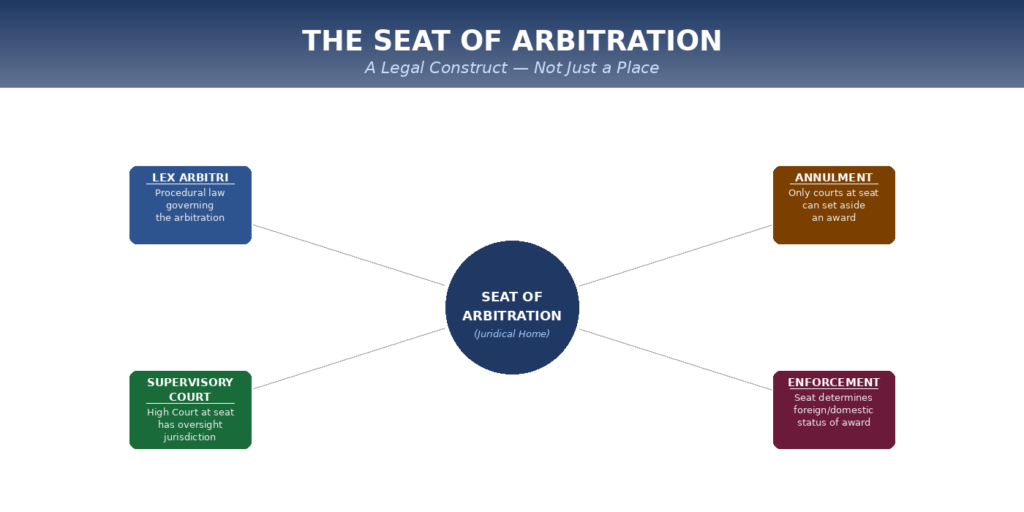
    Arbitration has emerged as the preferred mechanism for resolving commercial and investment disputes across the globe. At its heart lies a concept that is both deceptively simple and legally profound the seat of arbitration. The seat is not merely a pin on a map. It is the juridical home of the arbitration: a legal construct that determines the procedural law governing the proceedings, the court with supervisory jurisdiction, and the framework within which any award may be challenged or enforced.

    As the volume of commercial activity in Uganda continues to grow, and as the country positions itself as an investment destination within the East African Community and beyond, a clear understanding of the seat of arbitration and of how Uganda’s law treats it is increasingly indispensable for practitioners, businesses, and policymakers alike. This article examines the concept of the seat of arbitration, its legal significance, the statutory framework under the Arbitration and Conciliation Act, Cap. 4 (hereinafter the “Act”), and Uganda’s prospects and challenges as an arbitral seat.

    What is the Seat of Arbitration?

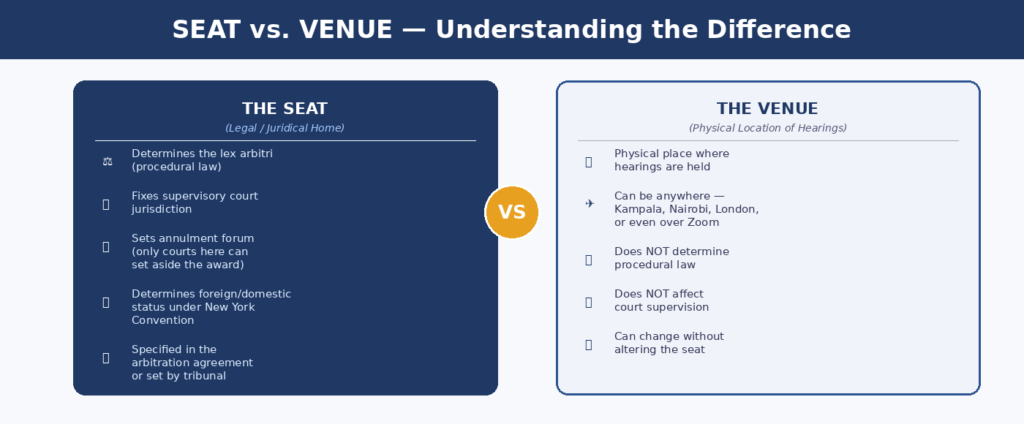
    The seat of arbitration, also referred to as the “place” of arbitration, is a legal concept that identifies the jurisdiction in which an arbitration is considered to occur. As has been aptly observed, the seat is “a legal construct, not a geographical location.” It does not necessarily refer to the physical location where parties and arbitrators convene hearings may take place in Kampala, Nairobi, Singapore, or entirely over video conferencing yet the seat, and therefore the governing procedural framework, remains wherever the parties have designated.

    The seat is best understood as the juridical domicile of the arbitration. It determines which country’s procedural laws, known as the lex arbitri, apply to the proceedings. These laws govern critical matters such as the appointment and challenge of arbitrators, the conduct of proceedings, the availability of interim measures, and most significantly the grounds upon which an award may be set aside.

    The Distinction Between Seat and Venue

    A common source of confusion in practice is the conflation of the seat of arbitration with the venue the physical location where hearings are held. These are distinct legal concepts. The seat establishes the legal framework and determines which courts have supervisory jurisdiction over the arbitration. The venue, on the other hand, is purely a matter of practical convenience and has no legal consequences in itself.

    This distinction is preserved under Uganda’s Act, and its practical implications are significant. Parties to an arbitration seated in Kampala may, for reasons of convenience, choose to hold their hearings in Nairobi or London. The physical location of those hearings does not alter the fact that Ugandan law governs the procedure, that Ugandan courts supervise the arbitration, and that any challenge to the award must be brought before the Ugandan courts.

    The Statutory Framework: Sections 19 and 20 of the Act

    The Arbitration and Conciliation Act, Cap. 4, which commenced on 19 May 2000, is Uganda’s principal statute governing both domestic and international arbitration. Modelled on the UNCITRAL Model Law on International Commercial Arbitration, the Act provides a framework that reflects internationally recognised principles while catering to Uganda’s specific legal context. Sections 19 and 20 of the Act are particularly central to the concept of the seat of arbitration.

    Section 19 — Determination of Rules of Procedure

    Section 19 of the Act establishes the procedural architecture of arbitral proceedings and embodies the foundational principle of party autonomy. Under subsection (1), the parties are free to agree on the procedure to be followed by the arbitral tribunal. This freedom is broad: parties may adopt the rules of an arbitral institution, craft their own bespoke procedure, or incorporate rules by reference in their arbitration agreement.

    Where the parties have made no such agreement, subsection (2) grants the tribunal wide discretion to conduct the arbitration in whatever manner it considers appropriate. This discretion expressly extends, under subsection (3), to matters of evidence the tribunal may determine the admissibility, relevance, materiality, and weight of any evidence placed before it. Unlike litigation, arbitration under the Act is therefore not bound by the formal rules of evidence applicable in court proceedings.

    Subsection (4) introduces an important procedural protection: every witness giving evidence and every person appearing before an arbitral tribunal enjoys at least the same privileges and immunities as witnesses and advocates in proceedings before a court. This provision ensures that the arbitral process commands a level of procedural integrity and dignity comparable to that of the formal court system, while preserving its distinctive flexibility.

    Section 20 — Place of Arbitration

    Section 20 is the provision most directly concerned with the seat. Under subsection (1), the parties are free to agree on the place of arbitration. This choice carries profound legal consequences it determines the lex arbitri, defines the supervisory court, and sets the stage for any annulment proceedings.

    Where the parties fail to agree on the place, subsection (2) empowers the arbitral tribunal to make that determination. The tribunal’s discretion must be exercised having regard to the costs involved, the circumstances of the case, and the convenience of the parties a balanced approach ensuring that the seat is not imposed in a manner that prejudices either party.

    Subsection (3) preserves the important distinction between seat and venue by providing that, notwithstanding the agreed or determined place of arbitration, the tribunal may meet at any location it considers appropriate for consultations, hearings, or inspection of documents, goods, or property. The legal seat therefore remains fixed, while the physical conduct of proceedings retains the flexibility that is one of arbitration’s most valued features.

    Why the Seat of Arbitration Matters

    The choice of seat carries far-reaching legal and practical implications. Understanding these consequences is essential both for parties entering arbitration agreements and for those already involved in proceedings.

    A. Governing Procedural Law (Lex Arbitri)

    The most immediate legal impact of the seat is the determination of the lex arbitri the procedural law governing the arbitration. This includes the rules applicable to the appointment and challenge of arbitrators, the availability of interim relief, the conduct of proceedings, obligations of confidentiality, and the extent to which courts may intervene in the arbitral process. A seat in Uganda therefore subjects the arbitration to the procedural regime of the Act, including its UNCITRAL-based framework.

    B. Court Supervision and Supervisory Jurisdiction

    Courts at the seat of arbitration exercise supervisory jurisdiction over the proceedings. In Uganda, this supervisory role is vested in the Commercial Division of the High Court. Under this jurisdiction, the court may appoint arbitrators where the parties cannot agree, decide on challenges to the appointment or conduct of arbitrators, grant interim measures in support of arbitration, and most critically entertain applications to set aside an arbitral award.

    Under Article I(1) of the 1958 New York Convention on the Recognition and Enforcement of Foreign Arbitral Awards, the determination of whether an award is a “foreign award” depends on the seat. Courts at the seat are therefore the “home court” of the arbitration, while courts elsewhere are treated as foreign courts with considerably more limited supervisory powers.

    C. Annulment Proceedings and Enforcement Risk

    Perhaps the most consequential implication of the seat relates to annulment. Only the courts at the seat have jurisdiction to set aside an arbitral award. This principle has been affirmed by Uganda’s High Court in cases such as Aya Investments (U) Limited v Industrial Development Corporation of South Africa Ltd, where the court held that an arbitral award can only be set aside at the seat of arbitration.

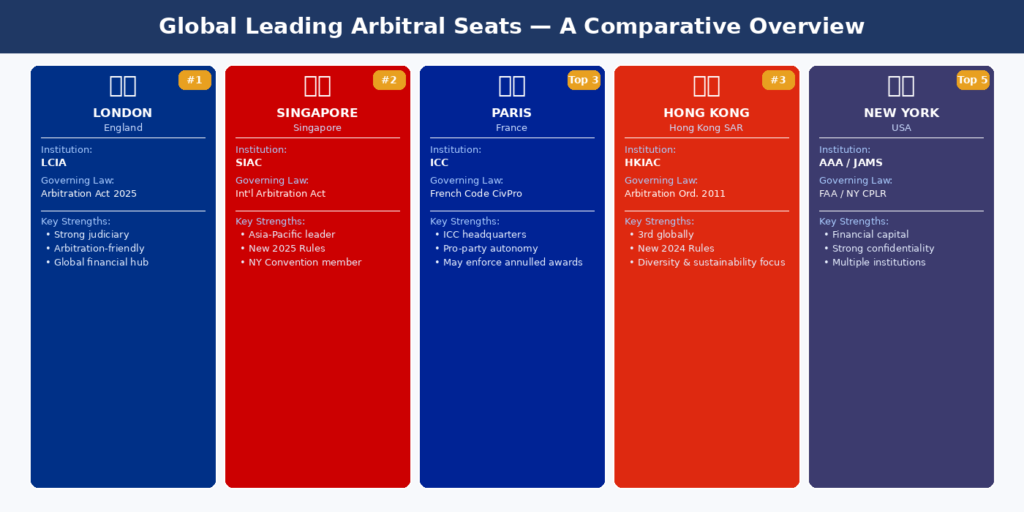
    If an award is set aside at the seat, enforcement in other jurisdictions may be refused under Article V(1)(e) of the New York Convention. While some jurisdictions, most notably France, may in narrow circumstances enforce awards that have been annulled at the seat, this remains the exception. In practice, an annulment at the seat can be fatal to enforcement efforts globally. The choice of a pro-arbitration seat is therefore a critical risk management decision.

    Uganda as a Seat of Arbitration

    A. The Legal Framework

    Uganda’s arbitration framework is, by design, conducive to effective arbitration. The Act, modelled on the UNCITRAL Model Law, enshrines party autonomy as a central organising principle. Ugandan courts have, in recent years, consistently affirmed their commitment to the principle of minimal judicial interference in arbitration. There is, in general, no right of appeal against a High Court decision on an application to set aside an arbitral award, except where the parties have agreed otherwise or where leave is granted.

    Uganda is also a signatory to both the New York Convention and the ICSID Convention, both of which are domesticated by the Act. This membership means that foreign arbitral awards are readily enforceable in Uganda and that awards made in Uganda are enforceable in the over 170 signatory states to the New York Convention. The Act further provides that an award shall be treated as made at the seat of the arbitration regardless of where it was signed, dispatched, or delivered — a provision that reinforces the legal primacy of the seat.

    B. Arbitral Institutions in Uganda

    The institutional landscape for arbitration in Uganda has grown meaningfully in recent years. The chartered institution of Arbitrators- Uganda chapter plays a big role in training and education of Uganda professions. The International Centre for Arbitration and Mediation in Kampala (ICAMEK), established in 2018 and officially recognised as an appointing authority under the Act by the Minister of Justice in 2020 through Legal Notice No. 4 of 2020, has attracted both domestic and international parties and maintains a panel with an increasing number of foreign international arbitrators. Its 2018 Arbitration Rules include provisions for the consolidation of separate proceedings and reflect standards comparable to other established regional centres. The Centre for Alternative Dispute Resolution (CADER) also continues to play a role in domestic dispute resolution.

    C. Challenges and the Path Forward

    Despite these foundations, Uganda faces genuine challenges in establishing itself as a preferred international seat. International arbitrations involving Ugandan parties have often been conducted under the auspices of ICSID or the ICC, with seats designated outside the country. The Uganda Law Reform Commission has acknowledged these limitations and has conducted a comprehensive review of the Act, culminating in the preparation of a draft amending Bill. The recommended reforms aim to address gaps in the existing framework, align Uganda’s legislation more closely with evolving international best practices, and enhance the clarity and effectiveness of the arbitration regime.

    Criteria for Choosing a Seat

    When selecting a seat of arbitration, parties and their counsel should weigh the following interconnected factors:

    1. The seat should have a modern arbitration law, ideally modelled on the UNCITRAL Model Law, that ensures the effective enforcement of awards.
    2. The local courts at the seat should be supportive of arbitration and refrain from undue interference in the arbitral process.
    3. The scope for appeals or challenges to awards on questions of law or substance should be limited, preserving the finality of the award.
    4. Recourse against awards should be available only in accordance with the spirit and provisions of the New York Convention narrow, internationally recognised, and predictable.
    5. The seat should ideally have an established track record, giving parties confidence that the legal framework has been tested.
    6. Practical considerations including cost, accessibility, and the availability of qualified arbitrators and legal counsel should also inform the decision.

    Applying these criteria to Uganda, the legal framework is sound and the judicial posture increasingly favourable. The remaining gap lies primarily in track record and institutional reputation factors built incrementally through consistent performance over time.

    Conclusion

    The seat of arbitration is not a technicality it is the legal home of your dispute. Get it right, and you have a clear procedural framework, a supportive court, and an enforceable award. Get it wrong, and the consequences can unravel everything.

  • Are You Reducing Your Tax Bill or Breaking the Law? Here’s the Difference

    Introduction

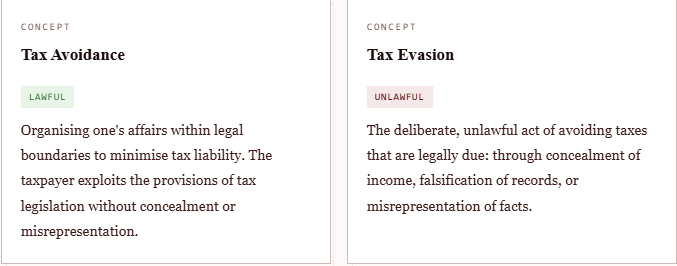
    The distinction between tax avoidance and tax evasion is one of the most significant concepts in revenue law. While both practices result in a reduction of the tax payable to the state, they differ fundamentally in their legal character: one is permissible, the other is a criminal offence.

    This paper examines both concepts within the Ugandan legal framework, drawing on judicial authority, academic commentary, and the Income Tax Act (Cap. 340).

    Definitions

    Academic Authority on Tax Avoidance

    Geoffrey Moses and Sandra Eden, in Principles of Tax Law, define tax avoidance as the act of organising one’s affairs within legal boundaries in order to reduce the tax bill, an approach that is considered entirely lawful. The taxpayer does not conceal any facts or misrepresent any transaction; rather, they exploit the provisions of the tax legislation to their advantage.

    Academic Authority on Tax Evasion

    Professor Bakibinga, in Revenue Law in Uganda (2nd ed, p. 205), defines tax evasion as the unlawful act of evading taxes. Unlike avoidance, evasion exposes the taxpayer to criminal liability and potential prosecution by the Uganda Revenue Authority.

    The Judicial Foundation: The Westminster Principle

    IRC v Duke of Westminster [1936] AC 1 · [1935] All ER Rep 501

    The Duke replaced his gardeners’ wages with periodic payments made under a deed of covenant, an arrangement that allowed him to claim a tax deduction and significantly reduce his liability. The House of Lords held the arrangement to be lawful.

    Lord Tomlin affirmed the right of every individual to arrange their affairs in such a manner as to attract less tax, provided those arrangements conform to the law. His Lordship emphasised that courts are bound by the literal meaning of tax legislation and cannot impute a tax liability that the statute does not impose.

    This became known as the Westminster Principle, a cornerstone of tax avoidance doctrine in common law jurisdictions, including Uganda. It privileges the legal form of a transaction over any inquiry into the taxpayer’s underlying motive.

    Uganda’s Anti-Avoidance Framework

    Recognising that the Westminster Principle could be abused, the Ugandan legislature incorporated anti-avoidance measures into Part XI of the Income Tax Act (Cap. 340). Two provisions are of particular significance.

    Section 116: Transactions Between Associates

    Section 116 empowers the Commissioner General to distribute, apportion, or allocate income, deductions, or credits between associated taxpayers where a transaction does not reflect an arm’s length dealing. The Commissioner may also adjust income from the transfer or licensing of intangible property between associates to ensure it is commensurate with its true economic value. This provision targets arrangements where related parties manipulate transactions to shift income or inflate deductions.

    Section 117: Re-characterisation of Transactions

    Income Tax Act (Cap. 340) · Section 117(2)

    A “tax avoidance scheme” includes any transaction, one of the main purposes of which is the avoidance or reduction of liability to tax.

    Section 117 grants the Commissioner General broad discretionary power to re-characterise transactions that form part of a tax avoidance scheme. Specifically, the Commissioner may:

    Re-characterise a transaction whose form does not reflect its substance; disregard a transaction that lacks substantial economic effect; or re-characterise any element of a scheme entered into with the purpose of avoiding or reducing tax liability.

    This provision introduces a substance-over-form approach, a significant departure from the strict literalism endorsed in the Westminster case, and reflects the legislature’s intent to close gaps that purely form-driven analysis might leave open.

    Judicial Application: WB v Commissioner of Income Tax

    WB v Commissioner of Income Tax 2 EATC 32

    The court considered whether an arrangement involving the transfer of shares to the taxpayer’s children, funded by loans purportedly made by the parents and repayable from dividend income, constituted a genuine commercial transaction or a tax avoidance scheme.

    The court held that the transfers of shares to the appellant’s children were genuine commercial transactions. The arrangement was not a sham devised to evade tax, and the transactions carried sufficient economic substance to withstand scrutiny under the applicable provisions of the Act.

    This case illustrates the courts’ willingness to look beyond the form of a transaction to assess its true commercial substance, an approach now codified in section 117 of the Income Tax Act, while also demonstrating that transactions with genuine economic effect will be respected even where they produce a tax benefit.

    Conclusion

    The line between lawful tax avoidance and unlawful tax evasion is a critical one in Ugandan revenue law. While the common law tradition recognises the taxpayer’s right to minimise their tax burden through legitimate planning, the Income Tax Act has progressively curtailed aggressive avoidance schemes through the anti-avoidance provisions of Part XI.

    The substance-over-form doctrine embedded in section 117 ensures that transactions devoid of genuine commercial purpose are not permitted to erode the tax base. Practitioners and taxpayers must therefore carefully navigate this boundary, exercising their lawful planning rights while remaining alert to the Commissioner General’s broad powers of re-characterisation.