
When we talk about Alternative Dispute Resolution in Uganda, most minds jump straight to arbitration or mediation. But there are other mechanisms one of which is rooted in our Constitution itself that rarely gets the attention it deserves.
Walk into any law firm in Kampala and ask about ADR, and you will almost certainly hear about arbitration clauses, mediation rules, and the Arbitration and Conciliation Act. These are important tools. But they do not tell the whole story.
Tucked inside the Judicature (Reconciliation) Rules, 2011 and backed by the Constitution of Uganda itself is a mechanism that predates both of these in spirit, and that is arguably more suited to the social and relational character of many Ugandan disputes: reconciliation.
This article explores what legislative reconciliation actually is, how it works, and why it matters not just as a legal curiosity, but as a practical tool for achieving justice in everyday disputes.
A constitutional foundation, not just a procedural option
Most ADR mechanisms derive their authority from contracts or statutes. Reconciliation goes further it is grounded in the Constitution of Uganda. Article 126(2)(d) directs that in adjudicating cases, courts shall apply the principle that reconciliation between parties shall be promoted.
This is reinforced by Section 160 of the Magistrates Courts Act, Cap. 19, which empowers magistrate courts to promote reconciliation and encourage amicable settlement in proceedings involving assault and other personal offences. Together, the Constitution and the statute create a framework that is both principled and operational.
So what exactly is reconciliation?
Rule 3 of the Judicature (Reconciliation) Rules, 2011 defines reconciliation as the bringing of two parties into harmony who would otherwise have been unable to settle their differences.
This philosophy aligns naturally with Uganda’s rich tradition of communal dispute resolution, where the goal of justice has always been the restoration of right relationships rather than merely the determination of rights.
Justice Mubiru captured this well in Uganda v Apiku (Criminal sessions Case No 0015 of 2018) (2018) UGHCCRO 59, where he described reconciliation as a means of building confidence in the justice system and meeting the needs of the parties central, in his words, to the rule of the judiciary.
Which disputes qualify?
Reconciliation under the 2011 Rules is available in criminal matters at the magistrate court level. The Schedule to the Rules lists eleven categories of offences for which reconciliation may be pursued:
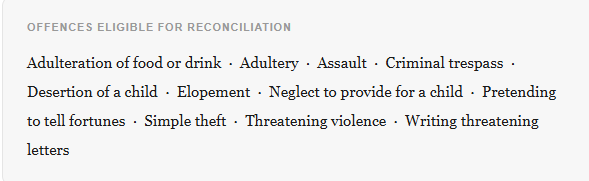
Notice the common thread: these are all personal offences disputes between people who know each other, often arising within families, neighbourhoods, or communities. The law deliberately limits reconciliation to these relational disputes, where restoring the relationship is both feasible and meaningful. Aggravated offences are expressly excluded.
How does the process actually work?
The procedure under Rule 7 is structured and court-supervised. Here is how it unfolds:
- Application — Either party, or the magistrate, initiates the process orally or in writing. The application is recorded in the court record.
- Notice and consent — The other party is informed and given the opportunity to accept or object. No one can be forced into reconciliation.
- Stay of proceedings — The criminal case is paused while reconciliation takes place.
- Appointment — A reconciliator is appointed by the magistrate, or the magistrate presides personally.
- Settlement agreement — If a settlement is reached, it is reduced to writing, signed by the parties, and presented to the magistrate for endorsement.
- Report and closure — The reconciliator submits a report with a transcript. If endorsed by the magistrate, the case is closed.
The entire process must be completed within 14 days, though this can be extended on sufficient cause, a timeline that is tight, but reflects the law’s preference for swift resolution.
One important lesson from the courts: in Abura V Uganda (Criminal Appeal no 240 of 2015), the court held that a reconciliation agreement from which one party withdraws, due to unresolved issues is a nullity. The agreement must be complete and final to have legal effect. Parties and reconciliators should not rush to paper over outstanding issues.
The remedies: where reconciliation truly stands apart
Perhaps the most striking feature of this framework is its remedial menu. Rule 12 gives the court the power to award any of the following:
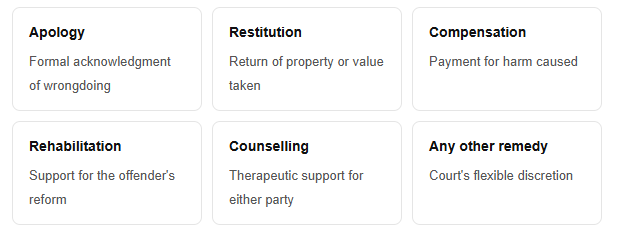
A criminal court operating in the conventional way cannot order any of these except compensation in narrow circumstances. It can convict and sentence; it cannot heal. Reconciliation can. A genuine apology, research consistently shows, is often more valuable to a victim than a fine or imprisonment. Counselling addresses the conditions that gave rise to the dispute. Rehabilitation looks forward, not backward.
This remedial palette reflects what legal scholars call therapeutic jurisprudence the idea that the law should promote the psychological wellbeing of the people it touches, not merely adjudicate their disputes.
Leave a Reply