
Introduction
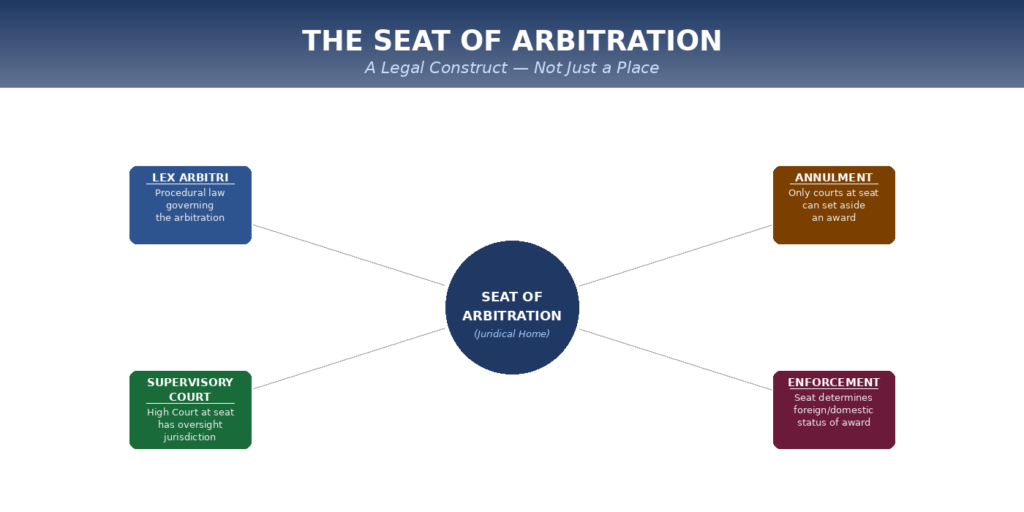
Arbitration has emerged as the preferred mechanism for resolving commercial and investment disputes across the globe. At its heart lies a concept that is both deceptively simple and legally profound the seat of arbitration. The seat is not merely a pin on a map. It is the juridical home of the arbitration: a legal construct that determines the procedural law governing the proceedings, the court with supervisory jurisdiction, and the framework within which any award may be challenged or enforced.
As the volume of commercial activity in Uganda continues to grow, and as the country positions itself as an investment destination within the East African Community and beyond, a clear understanding of the seat of arbitration and of how Uganda’s law treats it is increasingly indispensable for practitioners, businesses, and policymakers alike. This article examines the concept of the seat of arbitration, its legal significance, the statutory framework under the Arbitration and Conciliation Act, Cap. 4 (hereinafter the “Act”), and Uganda’s prospects and challenges as an arbitral seat.
What is the Seat of Arbitration?
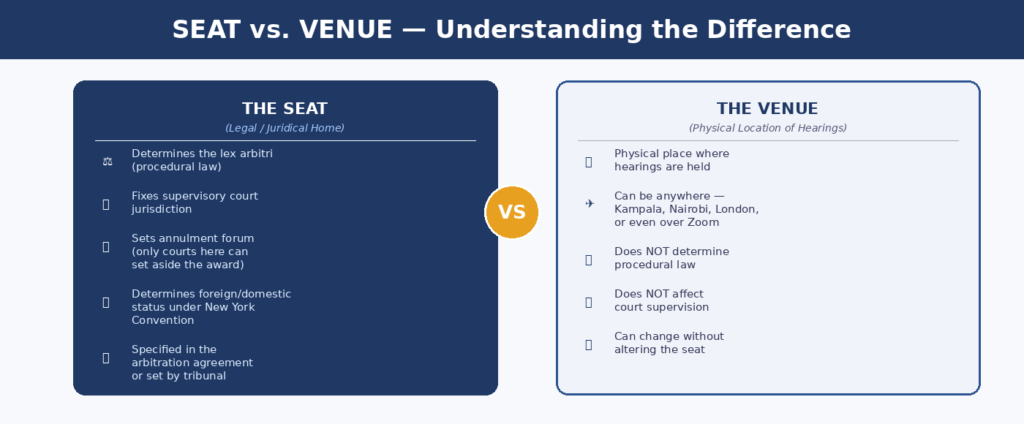
The seat of arbitration, also referred to as the “place” of arbitration, is a legal concept that identifies the jurisdiction in which an arbitration is considered to occur. As has been aptly observed, the seat is “a legal construct, not a geographical location.” It does not necessarily refer to the physical location where parties and arbitrators convene hearings may take place in Kampala, Nairobi, Singapore, or entirely over video conferencing yet the seat, and therefore the governing procedural framework, remains wherever the parties have designated.
The seat is best understood as the juridical domicile of the arbitration. It determines which country’s procedural laws, known as the lex arbitri, apply to the proceedings. These laws govern critical matters such as the appointment and challenge of arbitrators, the conduct of proceedings, the availability of interim measures, and most significantly the grounds upon which an award may be set aside.
The Distinction Between Seat and Venue
A common source of confusion in practice is the conflation of the seat of arbitration with the venue the physical location where hearings are held. These are distinct legal concepts. The seat establishes the legal framework and determines which courts have supervisory jurisdiction over the arbitration. The venue, on the other hand, is purely a matter of practical convenience and has no legal consequences in itself.
This distinction is preserved under Uganda’s Act, and its practical implications are significant. Parties to an arbitration seated in Kampala may, for reasons of convenience, choose to hold their hearings in Nairobi or London. The physical location of those hearings does not alter the fact that Ugandan law governs the procedure, that Ugandan courts supervise the arbitration, and that any challenge to the award must be brought before the Ugandan courts.
The Statutory Framework: Sections 19 and 20 of the Act
The Arbitration and Conciliation Act, Cap. 4, which commenced on 19 May 2000, is Uganda’s principal statute governing both domestic and international arbitration. Modelled on the UNCITRAL Model Law on International Commercial Arbitration, the Act provides a framework that reflects internationally recognised principles while catering to Uganda’s specific legal context. Sections 19 and 20 of the Act are particularly central to the concept of the seat of arbitration.
Section 19 — Determination of Rules of Procedure
Section 19 of the Act establishes the procedural architecture of arbitral proceedings and embodies the foundational principle of party autonomy. Under subsection (1), the parties are free to agree on the procedure to be followed by the arbitral tribunal. This freedom is broad: parties may adopt the rules of an arbitral institution, craft their own bespoke procedure, or incorporate rules by reference in their arbitration agreement.
Where the parties have made no such agreement, subsection (2) grants the tribunal wide discretion to conduct the arbitration in whatever manner it considers appropriate. This discretion expressly extends, under subsection (3), to matters of evidence the tribunal may determine the admissibility, relevance, materiality, and weight of any evidence placed before it. Unlike litigation, arbitration under the Act is therefore not bound by the formal rules of evidence applicable in court proceedings.
Subsection (4) introduces an important procedural protection: every witness giving evidence and every person appearing before an arbitral tribunal enjoys at least the same privileges and immunities as witnesses and advocates in proceedings before a court. This provision ensures that the arbitral process commands a level of procedural integrity and dignity comparable to that of the formal court system, while preserving its distinctive flexibility.
Section 20 — Place of Arbitration
Section 20 is the provision most directly concerned with the seat. Under subsection (1), the parties are free to agree on the place of arbitration. This choice carries profound legal consequences it determines the lex arbitri, defines the supervisory court, and sets the stage for any annulment proceedings.
Where the parties fail to agree on the place, subsection (2) empowers the arbitral tribunal to make that determination. The tribunal’s discretion must be exercised having regard to the costs involved, the circumstances of the case, and the convenience of the parties a balanced approach ensuring that the seat is not imposed in a manner that prejudices either party.
Subsection (3) preserves the important distinction between seat and venue by providing that, notwithstanding the agreed or determined place of arbitration, the tribunal may meet at any location it considers appropriate for consultations, hearings, or inspection of documents, goods, or property. The legal seat therefore remains fixed, while the physical conduct of proceedings retains the flexibility that is one of arbitration’s most valued features.
Why the Seat of Arbitration Matters
The choice of seat carries far-reaching legal and practical implications. Understanding these consequences is essential both for parties entering arbitration agreements and for those already involved in proceedings.
A. Governing Procedural Law (Lex Arbitri)
The most immediate legal impact of the seat is the determination of the lex arbitri the procedural law governing the arbitration. This includes the rules applicable to the appointment and challenge of arbitrators, the availability of interim relief, the conduct of proceedings, obligations of confidentiality, and the extent to which courts may intervene in the arbitral process. A seat in Uganda therefore subjects the arbitration to the procedural regime of the Act, including its UNCITRAL-based framework.
B. Court Supervision and Supervisory Jurisdiction
Courts at the seat of arbitration exercise supervisory jurisdiction over the proceedings. In Uganda, this supervisory role is vested in the Commercial Division of the High Court. Under this jurisdiction, the court may appoint arbitrators where the parties cannot agree, decide on challenges to the appointment or conduct of arbitrators, grant interim measures in support of arbitration, and most critically entertain applications to set aside an arbitral award.
Under Article I(1) of the 1958 New York Convention on the Recognition and Enforcement of Foreign Arbitral Awards, the determination of whether an award is a “foreign award” depends on the seat. Courts at the seat are therefore the “home court” of the arbitration, while courts elsewhere are treated as foreign courts with considerably more limited supervisory powers.
C. Annulment Proceedings and Enforcement Risk
Perhaps the most consequential implication of the seat relates to annulment. Only the courts at the seat have jurisdiction to set aside an arbitral award. This principle has been affirmed by Uganda’s High Court in cases such as Aya Investments (U) Limited v Industrial Development Corporation of South Africa Ltd, where the court held that an arbitral award can only be set aside at the seat of arbitration.
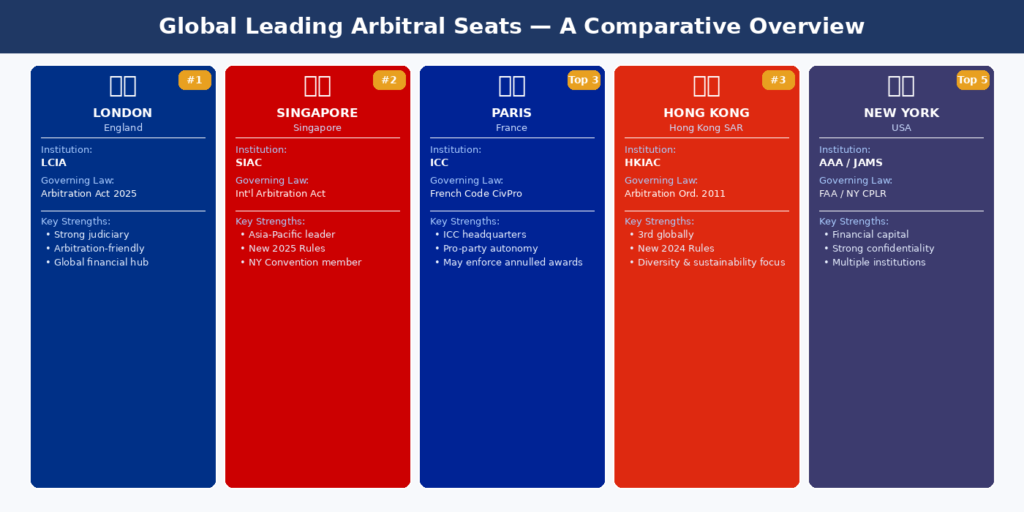
If an award is set aside at the seat, enforcement in other jurisdictions may be refused under Article V(1)(e) of the New York Convention. While some jurisdictions, most notably France, may in narrow circumstances enforce awards that have been annulled at the seat, this remains the exception. In practice, an annulment at the seat can be fatal to enforcement efforts globally. The choice of a pro-arbitration seat is therefore a critical risk management decision.
Uganda as a Seat of Arbitration
A. The Legal Framework
Uganda’s arbitration framework is, by design, conducive to effective arbitration. The Act, modelled on the UNCITRAL Model Law, enshrines party autonomy as a central organising principle. Ugandan courts have, in recent years, consistently affirmed their commitment to the principle of minimal judicial interference in arbitration. There is, in general, no right of appeal against a High Court decision on an application to set aside an arbitral award, except where the parties have agreed otherwise or where leave is granted.
Uganda is also a signatory to both the New York Convention and the ICSID Convention, both of which are domesticated by the Act. This membership means that foreign arbitral awards are readily enforceable in Uganda and that awards made in Uganda are enforceable in the over 170 signatory states to the New York Convention. The Act further provides that an award shall be treated as made at the seat of the arbitration regardless of where it was signed, dispatched, or delivered — a provision that reinforces the legal primacy of the seat.
B. Arbitral Institutions in Uganda
The institutional landscape for arbitration in Uganda has grown meaningfully in recent years. The chartered institution of Arbitrators- Uganda chapter plays a big role in training and education of Uganda professions. The International Centre for Arbitration and Mediation in Kampala (ICAMEK), established in 2018 and officially recognised as an appointing authority under the Act by the Minister of Justice in 2020 through Legal Notice No. 4 of 2020, has attracted both domestic and international parties and maintains a panel with an increasing number of foreign international arbitrators. Its 2018 Arbitration Rules include provisions for the consolidation of separate proceedings and reflect standards comparable to other established regional centres. The Centre for Alternative Dispute Resolution (CADER) also continues to play a role in domestic dispute resolution.
C. Challenges and the Path Forward
Despite these foundations, Uganda faces genuine challenges in establishing itself as a preferred international seat. International arbitrations involving Ugandan parties have often been conducted under the auspices of ICSID or the ICC, with seats designated outside the country. The Uganda Law Reform Commission has acknowledged these limitations and has conducted a comprehensive review of the Act, culminating in the preparation of a draft amending Bill. The recommended reforms aim to address gaps in the existing framework, align Uganda’s legislation more closely with evolving international best practices, and enhance the clarity and effectiveness of the arbitration regime.
Criteria for Choosing a Seat
When selecting a seat of arbitration, parties and their counsel should weigh the following interconnected factors:
- The seat should have a modern arbitration law, ideally modelled on the UNCITRAL Model Law, that ensures the effective enforcement of awards.
- The local courts at the seat should be supportive of arbitration and refrain from undue interference in the arbitral process.
- The scope for appeals or challenges to awards on questions of law or substance should be limited, preserving the finality of the award.
- Recourse against awards should be available only in accordance with the spirit and provisions of the New York Convention narrow, internationally recognised, and predictable.
- The seat should ideally have an established track record, giving parties confidence that the legal framework has been tested.
- Practical considerations including cost, accessibility, and the availability of qualified arbitrators and legal counsel should also inform the decision.
Applying these criteria to Uganda, the legal framework is sound and the judicial posture increasingly favourable. The remaining gap lies primarily in track record and institutional reputation factors built incrementally through consistent performance over time.
Conclusion
The seat of arbitration is not a technicality it is the legal home of your dispute. Get it right, and you have a clear procedural framework, a supportive court, and an enforceable award. Get it wrong, and the consequences can unravel everything.


Leave a Reply to Peter Cancel reply